
By Waseda University Publishing Society (Masukomi Kenkyukai)
Translated and adapted from the Japanese version: https://waseda-massken.com/k-sorita/
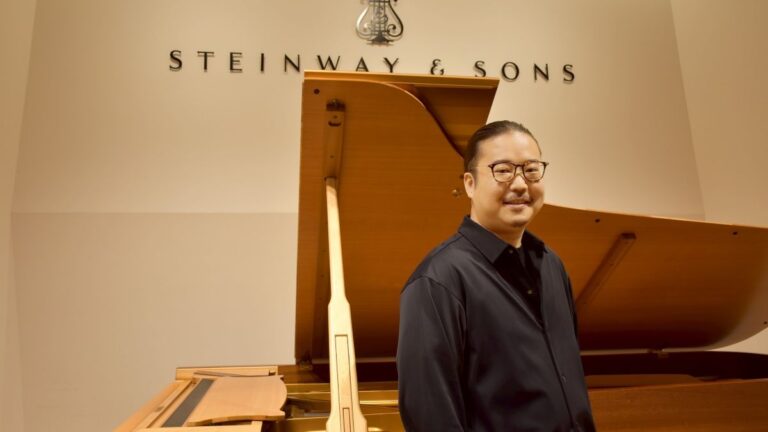
Pianist and conductor Kyohei Sorita rose to international prominence after winning second prize at the 18th International Chopin Piano Competition in 2021. As he expands his career beyond performance into cultural entrepreneurship, he also thinks about the future of Japan’s classical music scene. We spoke to him about inspiration, ambition, and why classical music still matters today.
‘I felt a breeze passing through me’
When did you first fall in love with classical music?
I was about eleven. I’d been playing the piano since early childhood, but I was far more interested in soccer and even dreamed of becoming a professional player. But everything changed when I got a chance to conduct the orchestra at a music workshop. The moment I brought the baton down, I felt a breeze passing through me. I remember thinking, ‘This is incredible’.
And when I was twelve, I applied to take part in a television music project and was given another opportunity to conduct. I led Beethoven’s Symphony No. 7, the fourth movement, which many people knew as the theme from the drama, Nodame Cantabile. This experience convinced me that what I really want is to conduct.
Why do you think classical music attracts people?
Classical music offers us something like a place of emotional refuge. Long before language existed, humans communicated through sound and rhythm. Considering that music has continued to evolve in form and yet been sustained to this day, I believe that music — regardless of genre — is something essential to human beings.
Classical music, in particular, has survived for centuries, still fascinating audiences all over the world. Even other music genres, such as pop or jazz, have their roots in it. Obviously, classical music has something that speaks directly to us.
Compared with other genres, what makes classical music distinctive?
Classical music has the ability to move people beyond language. There’s something magical. When I sit at the piano and begin to play, people gather, listen, and respond. They recognise my existence through music. And I’ve met countless friends and collaborators because I play music. It has an extraordinary power to bring people together.
Have you ever noticed similarities between classical music and other fields?
Yes, very often. You can see parallels anywhere discipline and craftsmanship are valued, such as in cuisine or sports, not just in music.For example, a concert programme is a bit like a course meal. In many cases, musicians begin with a shorter piece to introduce themselves, followed by several pieces, like starters and a fish course. After the interval comes the main work, the centrepiece of the evening. And the encore is a dessert.
Or, just think of several chefs preparing the same salad dressing: each one will taste slightly different. In the same way, four pianists playing the same piece will have four different sounds. In such a way, individuality makes each performance unique and special.
And how about similarities with the sport you mentioned earlier?
When I perform in a concert hall, I sometimes enter a kind of flow state when I’m completely focused. It feels as if time slows down. I’ve heard athletes describe something similar.
I once heard a soccer player being asked what he thinks about when stepping onto the pitch, and he answered that he imagines scoring a goal and hearing the crowd yelling. It’s very similar for me. Before the performance, no matter how nervous I may be, I always envision the audience applauding, calling out ‘bravo’, smiling, etc. Professionals across many different fields often share this sort of mindset.
A Gateway into Classical Music
Can manga or anime be a gateway into classical music?
Absolutely. When I was younger, I learned a lot about music through manga, drama and anime series like Nodame Cantabile and Forest of Piano (Piano no Mori).
Nodame Cantabile isn’t just about music, but its humour and romance make it especially enchanting. Forest of Piano also explores the world of classical music in depth, centred on the Chopin Competition. I was reading it just as I began to dream of competing myself in the Competition, so I could see my own aspirations reflected in the story.
Both series introduce not only famous pieces but also lesser-known works, offering a broad and engaging introduction to classical music.
Could you recommend some pieces for people who don’t usually listen to classical music?
I think it helps to start with something that feels already familiar to you. For example, if you’re a fan of soccer, I’d suggest the Triumphal March from Aida by Verdi. If you watch TV adverts, you might recognise the 18th Variation from Rhapsody on a Theme of Paganini by Rachmaninoff. And if you’re a film lover, you could begin with pieces featured in films. They’re easy to find online, so I’d encourage people just to give them a try.
Is there any particular way to listen to classical music when you’re just starting out?
If you’re a beginner, just listen to whatever draws you in. As you become more familiar with the music, you might start noticing the differences between performers, conductors and orchestras.
Even if you admire a particular musician, it’s worth remembering that one interpretation never would be the whole story. There isn’t a single ‘correct’ way to play a piece. No performer can fully recreate exactly what a composer once imagined, and their own lives and experiences inevitably shape the way they perform. That’s why it can be so rewarding to compare different interpretations of the same work.
What is the value of going to concerts rather than listening to recordings?
A big part of the attraction of live concerts lies in their unpredictability. If all you want is technical perfection, recordings can easily provide that. But people go to concerts in search of something more – the energy in the hall and the sense of tension.
In a concert, nobody in the audience is moved in the same way. That isn’t simply a matter of the performer’s condition or even the quality of the music itself; it also depends on each listener. Our experiences are shaped by our emotions, what has happened to us that day, and how familiar we are with the piece. The more we know about the music and its background, the more we can gain from a live concert.
How can we encourage younger audiences to engage more with classical music?
The classical music world can be surprisingly conservative. In Japan, major concert halls still rely heavily on printed flyers, which can feel out of step with the digital age.
One of my dreams is to create an app dedicated to classical music, where people could book tickets, buy recordings, and read cultural news all in one space. If we truly want to reshape the future of the field, we need to think more seriously about how to connect with younger generations.
However, developing my ideal app is extremely costly; the annual maintenance alone is estimated to cost around 200 million yen, so it would be difficult to realise without substantial support.
- 1
- 2